Showing posts with label blending. Show all posts

Tuesday, 11 October 2016

Halloween Phonics game

I made this little Halloween game - perfect for practising blending.
You can download it from this link: Halloween Phonics game

Thursday, 26 May 2016

Snakes

I cannot take credit for thinking up this game because I saw something similar posted but the words were too difficult for the little one I am thinking would love this.

Print onto card and cut up or laminate then cut up. Lay all the cards face down and the child picks a card and reads it. If correct they keep the card. The aim of the game is to make up as many snakes as possible. The person who does at the end of the game is the winner.

Download: Snakes


Tuesday, 24 May 2016

SATPIN Phonics booklet - 40 pages

This booklet will take children through the first 6 sounds of phase 2. They will learn to recognise them, write them, read them, hear the first sound and blend them. Booklet in black and white to take into account printing costs and also to allow the children to colour themselves. There are some fab monsters!
Download: Phonics Booklet


Sunday, 22 May 2016

Can you make a real word (or alien word)

This is a fab little activity/game for helping children to practise blending.

Phase 2 /i/
Phase 2 /o/
Phase 2 /u/
Phase 2 /e/
Phase 2 /a/

Phase 3 consonant digraphs


•Laminate and cut out the letters.
•Deal the cards between two players.
•Ask the child to pick a card.
•Read the sound then look at the first box on the game board. Does it make a real word or an alien word? Encourage the use of the sound buttons. If it makes an alien word (nonsense) word then they can place it on the board. If it makes a real word then the word goes to the bottom of their pile.
•The next person picks a card and tries to place it on the next available box. Continue until all the boxes are filled and someone reaches the finish box.

•The person with the least cards left is the winner.

I have done two different games - one making alien words(much easier) and one making real words. You can obviously do either on any of the boards.


I played this game with one of my children and it worked brilliantly. It gave LOTS of blending practice which was the intention and also lots of discussion on real words and nonsense words.


Wednesday, 18 May 2016

Name the Alien (Phase 5)

This is a big pack of resources for the following activity and is available to purchase for £1 from my ELSA website if you are interested. Name the Alien Resource


Here is how you can use this resource and I must say it worked brilliantly with a child I am working with who tends to guess at words and doesn't apply her phonics to blend. She was very motivated to make as many different names for the alien as possible.


First of all I introduced the Alien and told her he came from the planet /ay/. We repeated the sound and I asked the child to write the sound on a whiteboard so she could remember it. I then told her that she had a challenge to name him. He didn't have a name and she had to make a name for him. I asked her to cut out the cards. Lots of scissor practise to help motor skills needed here. I then asked her to read all the sounds to me to ensure she knew them all. She remembered the /ay/ sound. I told her that we had to have the /ay/ sound in his name because he was from the planet /ay/.
I then showed her the phoneme frame and told her that if she needed to press the sound buttons she could. I told her to rearrange the sounds in the boxes to make the names. She LOVED this and made loads of names, constantly blending over and over again using that /ay/ sound. Everytime she made a new name I asked her to write it on her sheet (see below). This reinforced the /ay/ sound and also segmenting skills. She wanted to make a HUNDRED but unfortunately time was an issue so I stopped her when she had done a reasonable amount. I then asked her to choose her favourite name. Again she blended and read every name that she had written to choose her favourite which was Zzayn.


To extend this activity further the child could describe their alien using adjectives and then write a few sentences about him.

Tuesday, 17 May 2016

Race to the top of the Rocket

Similar to the race to the top of the castle resource. All you need is a die and two pegs. Print and laminate the sheet. Place both pegs at the bottom, one at each side. Throw the die and move that number of places upwards. Read the word. If correct the child moves their peg there. Who can reach the top first? You have to throw the right number on the die to finish.

Download: Race to the top of the Rocket


Saturday, 14 May 2016

Race to the top of the castle

All you need is a die and two pegs. Print and laminate the sheet. Place both pegs at the bottom, one at each side. Throw the die and move that number of places upwards. Read the word. If correct the child moves their peg there. Who can reach the top first? You have to throw the right number on the die to finish.

Download: Race to the top of the castle 

Spin, read and write

I have just made this to use for all the children I tutor. Print onto A3, laminate and pop a spinner into the wheel. You can buy these from Amazon or just use a pencil and a paper clip spinner. Using a whiteboard pen write the focus sounds or words on the spinner. Each child has a different coloured whiteboard pen and they take it in turns to spin the wheel, read the word and then write the word on the grid. The aim of the game is for them to get three words in a row either horizontally, vertically, or diagonally.

You can work on different phases, different sounds, words using a focus sound, cvc words or even tricky words. Children get practice at reading, and writing (insist on correct letter formation).
Download: Spin, read and write


Friday, 13 May 2016

Find the treasure

Treasure as in REAL words. Each child throws a die. Move that number of places and read the word. If it is real they get a counter. If it is an alien word they don't get anything. The person who has the most counters at the end of the game is the winner.

Download: Find the treasure


Name the Alien

This is a phoneme frame with 3 sounds. The child must cut out the sounds from the second sheet and make different names. When they find one they like they have 'Named the Alien'.

Download: Name the Alien


Real or Alien - cut and stick

The child must cut out the words and sort them between real words and alien words.
Download: Real or Alien


Alien game

These game cover all the phase 5 sounds except u-e. The maths just wouldn't work out to make all the sounds.

All you need is a die and some counters (2 colours, each person has a different colour). Take in turns to throw the die, read the corresponding sound and then find a word with that sound. Read the word and then cover with your counter. If all the words are gone then you miss a turn. At the end of the game the person with the most counters on their board wins.

Download: Alien game
Download: Alien game 2
Download: Alien game 3


What's the Alien's name?


This activity is to help a child to blend using phase 5 phonics. This first sheet is just for the /ay/ sound. The child must make up as many names for the alien that they can using the grid. They MUST put the /ay/ sound in each name. They must then choose their favourite name for the alien.

Download: What's the alien's name?


Monday, 20 July 2015

Paper chains

How do you encourage a reluctant writer? I am trying at present to encourage a child who is reluctant to write, mainly due to a confidence issue. I have often used paper chains in other areas of work but thought I would try it with writing and phonics.

We played the spinner game from last week, wrote the words on the 'Race the word' grid and then I asked the child to write each word on a paper chain link to make a paper chain of her writing to display. She crossed off each word as she wrote it. She was very motivated to do this and we ended up with an 8 link paper chain. Next week we will add more words to it. You could do this with tricky words, or just letter formation and learning sounds.


Monday, 13 July 2015

Race the words

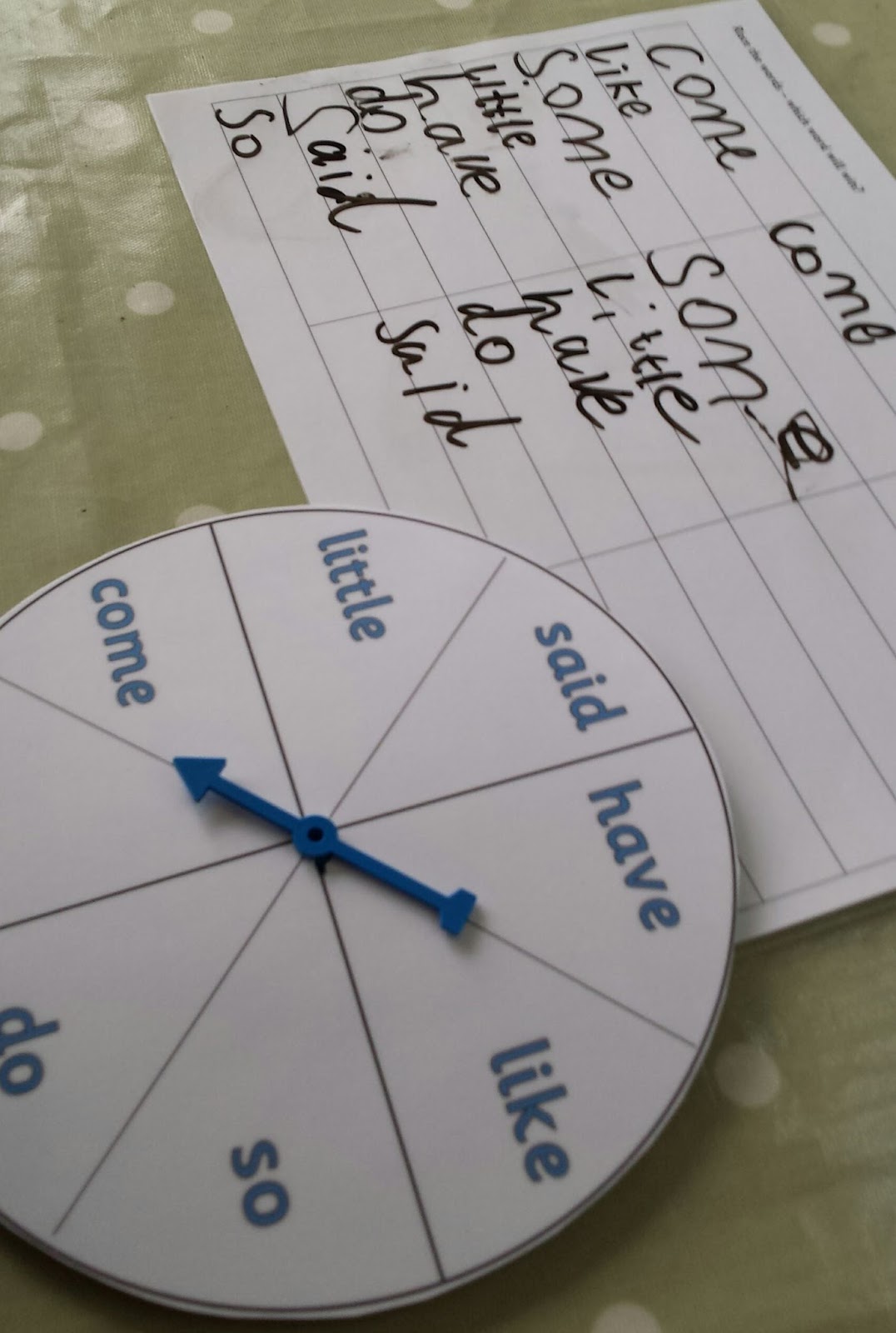
This idea is brilliant for practising all sorts of words. The image is of a session with one of the children I tutor. I have done the same session but with different words. We were working on phase 4 tricky words.

I just want to say something about tricky words. Some people seem to think that children should just learn these as sight words but evidence shows that if you teach them phonically they are much more likely to stick. You may think that some words aren't decodable. All words are decodable but there are obviously different representations of the sounds. In every word there will be something to go on.
For example /said/ has the /s/ and the /d/ which you can point out. The child needs to know that in this word /ai/ makes the /e/ sound. It is surprising how quickly they pick it up if you do point out the decodable parts and then point out the different representation of the sounds.

Back to the game. Basically it is a spinner which you can write any words in each section. I worked on cvc words with another child who isn't as far on as this one. They spin the spinner (they all love doing that) then they must read the word. When they have read it, turn the spinner over and ask them to write it in the first column and row of the grid. There are eight rows in this grid to match the number of words. They spin again and if they get a different word it goes underneath the first word. However if they spin the same word then it goes into the next column. The idea is to see which word wins. Repeat as many times as possible to practise all the words. Children love playing this game. You can buy the spinners off Amazon. and can download the word version of the spinner below. I have changed the font to comic sans due to the fact that the one I use is Sassoon primary and you may not have that one installed on your computer so it will look slightly different.

After we had played the game the word that 'won' was used in a sentence and written on the back of the laminated grid. That image is below.

Download 'Race the words'


Saturday, 25 April 2015

What do children need to be able to do before blending sounds to make words?

There are lots of things children need to be able to do before blending to read. I often feel children are rushed into this phase and so make poor progress. Taking a bit of time with these pointers will add to the success of blending.

Download this image in PDF format

  • What is a word? What is a letter? When looking at a book ask the child to point to a letter. Then ask them to point to a word. You will be surprised how many do not know this basic vocabulary. Yet we are asking them to blend sounds or letters to make words.
  • We read from left to right. Children need to know this. They need to know that we start blending on the left and blend to the right to make the word. They need to know that when we get to the end of a line of print we go to the beginning of the next line.
  • They need to know the phoneme/grapheme correspondences automatically. Not all of them straight away but just the ones that you are expecting them to blend with. You might have taught satpin and so are now ready to begin blending. Show the letter and they just KNOW it. The longer it takes them to recall the letter sound the more unlikely they will be to be able to blend. It's all short term memory and the fact that they will forget the sounds they have said, and can't hear the word because they have said them too slowly.
  • Articulation of sounds. Children must say the sounds correctly. If you are teaching them then you must learn them yourselves properly. There are lots of videos on youtube which illustrate articulation of sounds. Try Ruth Miskins who has some videos on articulation and blending. When children add a schwa at the end of a letter for example muh, suh, cuh they will not get the word. Take a word back yourselves and think about what sound you actually hear in the word. for example man mmmmannnnn not muh a nuh. When I first started many years ago I always broke a word up first myself before asking a child to blend and read that way I could guarantee they were saying it properly and could correct when necessary.
  • It is helpful to be able to hear rhyming words or continue a rhyming chain. Say mat, bat, cat ...what other words can they think of that rhyme with those words? Give them a selection of picture cards cat, mat hen. Which two words rhyme? Look at rhyming words when you read to them. There are loads of books that are written in rhyme.
  • Oral blending - children MUST be able to hear a word when you say the sounds. If they cannot do this then how on earth will they be able to do blend sounds to make words themselves? You must teach this constantly. During the school day ask for things from the child - can you pass me the p/e/n? As I have said in my other posts give children clues to begin with to help tune them into what you are asking them to do. Oral segmentation is more for writing but still important that children can hear the different sounds in words.
  • They must be able to listen to themselves when they say the sounds. They get used to us sounding out for them with oral blending. The focus must be on their voice and short term memory. Practice this by pointing to a sound asking them to say it then asking them again what did they say? Point to 2 sounds. What are they? Say them again. Point to 3 sounds. What are they? Say them again. Practising short term memory and listening to themselves. You can buy or make little phonic phones which are helpful for this. Really focusing them into what they are hearing. Also make sure their hearing is ok. Children who struggle with hearing can struggle with phonics. 
  • Smooth blending. Children need to hear you saying the sounds smoothly. If you say them in a choppy robotic way they will never get it! Try modelling how to say them smoothly. Practice singing the sounds in your head first so that you can get the smoothness. Encourage children to say them smoothly when practicing oral blending. 
  • Eye tracking - children need to be able to track words/letters with their eyes from left to right. You can practice eye tracking using bubbles or balloons. Blow bubbles and ask the child to follow the bubble with their eyes. Bat a ballon up into the air and ask them to watch the balloon at all times. Smooth eye tracking really helps children to read. Also use a ruler underneath the words or encourage them to use a finger to follow each word in turn. 
  • Compound words - can the child give you the word when you say the two syllables in a compound word. So for example lap...top = laptop, flip....flop = flipflop, hand....bag =handbag. Practice this too. If they can't do this they they won't be ready to blend.

Sunday, 19 April 2015

Sorting words

Another great activity to encourage children to look carefully for vowel digraphs is 'word sort'
Children can cut and stick the word in the correct column or they can write the words in the correct column and then cross them off. Depends if they need practice at writing or cutting skills really.

Download Word sort


Saturday, 18 April 2015

Recognising vowel digraphs in words

Children need to really know the different representations of the vowel digraphs to be able to read them automatically. This is one way to help children do that.

One of the children I work with knows all these sounds but doesn't recognise them in words.

The idea is for the child to really look at the words, read them and highlight them in different colours. This really focuses them into the sounds they are searching for.

Download ay/ai/a-e search


Tuesday, 14 April 2015

Polysyllabic words - blending and segmenting

One of the things children find difficult is when they meet a long word. How many times do you hear children sounding out every letter and not getting the word? Teach children how to chunk the words so that they read a bit at a time then put it together. What you are actually teaching is syllables. Children read one syllable and then the next syllable. It is good to practice this skill with compound words such as sunset, giftbox, sandpit, etc.

Last night I based my lesson around syllables. I wrote the word on a whiteboard and we looked at where the vowels are. In sunset there are two vowels. Ask the child to read around the first vowel to get 'sun' and then read around the next vowel to get 'set'. Then put them together to get sunset. It takes some practice but children soon begin to chunk when reading themselves. It might be a good idea to teach children which letters are vowels. There is the vowel rap from the old ELS scheme which has a nice rap. I use this for letter sounds and letter names. It goes:

aeiou that is how we say them
aeiou that is how we play them
We say them soft
We say them loud
of our vowels we sure are proud
aeiou (shout)
aeiou (whisper)
that is how we say them

When teaching children how to write words with more than one syllable you must teach them about syllables first. Lots of practice and counting how many syllables there are in words. Either clap the syllables or get the child to put their hand under their chin as they say the word. Each time their chin touches their hand is a syllable. Try it! It works!

When spelling ask the child to say the word. How many syllables? Write the first syllable so for example in sunset there are two syllables. The child writes the first syllable 'sun' and then the second syllable 'set' to get the word 'sunset'. This really helps children with spelling.

Here is a photo of some polysyllabic words a child who is five year old was writing with me last night. She continued on the back of the white board with more words of her choice but I didn't take a photograph. She wrote oven, kitchen, pencil etc. It was as if a barrier had been opened. I am hoping for some lovely long words from her in the next few weeks. These words were totally her work I had no input what so ever apart from asking her to count the syllables, write the first syllable and write the second syllable.


Monday, 23 March 2015

Blending mats

Sometimes children really struggle to blend and I use these to help. Smooth blending is helpful for children who cannot put those sounds together. Try and make the sounds blend into each other even if the sound is a short sound. For example iiiiiiiit, aaaaat, iiiiiin. Try singing it to help. You won't always need to do this. It is often a eureka moment for some children when they eventually click.

Download: Blending mat (3 box with car and road)

Download: Blending mat (3 box with arrow)

Download: Blending mat (4 box with arrow)

Download: Blending mat (2 box with car and road)

Download Blending mat (2 box with arrow)

Download Blending mat (4 box with car and road)