This booklet will take children through the first 6 sounds of phase 2. They will learn to recognise them, write them, read them, hear the first sound and blend them. Booklet in black and white to take into account printing costs and also to allow the children to colour themselves. There are some fab monsters!
Download: Phonics Booklet
Showing posts with label segmenting. Show all posts
Tuesday, 24 May 2016
Wednesday, 18 May 2016
Name the Alien (Phase 5)
Here is how you can use this resource and I must say it worked brilliantly with a child I am working with who tends to guess at words and doesn't apply her phonics to blend. She was very motivated to make as many different names for the alien as possible.
I then showed her the phoneme frame and told her that if she needed to press the sound buttons she could. I told her to rearrange the sounds in the boxes to make the names. She LOVED this and made loads of names, constantly blending over and over again using that /ay/ sound. Everytime she made a new name I asked her to write it on her sheet (see below). This reinforced the /ay/ sound and also segmenting skills. She wanted to make a HUNDRED but unfortunately time was an issue so I stopped her when she had done a reasonable amount. I then asked her to choose her favourite name. Again she blended and read every name that she had written to choose her favourite which was Zzayn.
To extend this activity further the child could describe their alien using adjectives and then write a few sentences about him.
Saturday, 14 May 2016
Spin, read and write
I have just made this to use for all the children I tutor. Print onto A3, laminate and pop a spinner into the wheel. You can buy these from Amazon or just use a pencil and a paper clip spinner. Using a whiteboard pen write the focus sounds or words on the spinner. Each child has a different coloured whiteboard pen and they take it in turns to spin the wheel, read the word and then write the word on the grid. The aim of the game is for them to get three words in a row either horizontally, vertically, or diagonally.
You can work on different phases, different sounds, words using a focus sound, cvc words or even tricky words. Children get practice at reading, and writing (insist on correct letter formation).
Download: Spin, read and write
You can work on different phases, different sounds, words using a focus sound, cvc words or even tricky words. Children get practice at reading, and writing (insist on correct letter formation).
Download: Spin, read and write
Monday, 20 July 2015
Paper chains
How do you encourage a reluctant writer? I am trying at present to encourage a child who is reluctant to write, mainly due to a confidence issue. I have often used paper chains in other areas of work but thought I would try it with writing and phonics.
We played the spinner game from last week, wrote the words on the 'Race the word' grid and then I asked the child to write each word on a paper chain link to make a paper chain of her writing to display. She crossed off each word as she wrote it. She was very motivated to do this and we ended up with an 8 link paper chain. Next week we will add more words to it. You could do this with tricky words, or just letter formation and learning sounds.
Monday, 13 July 2015
Race the words
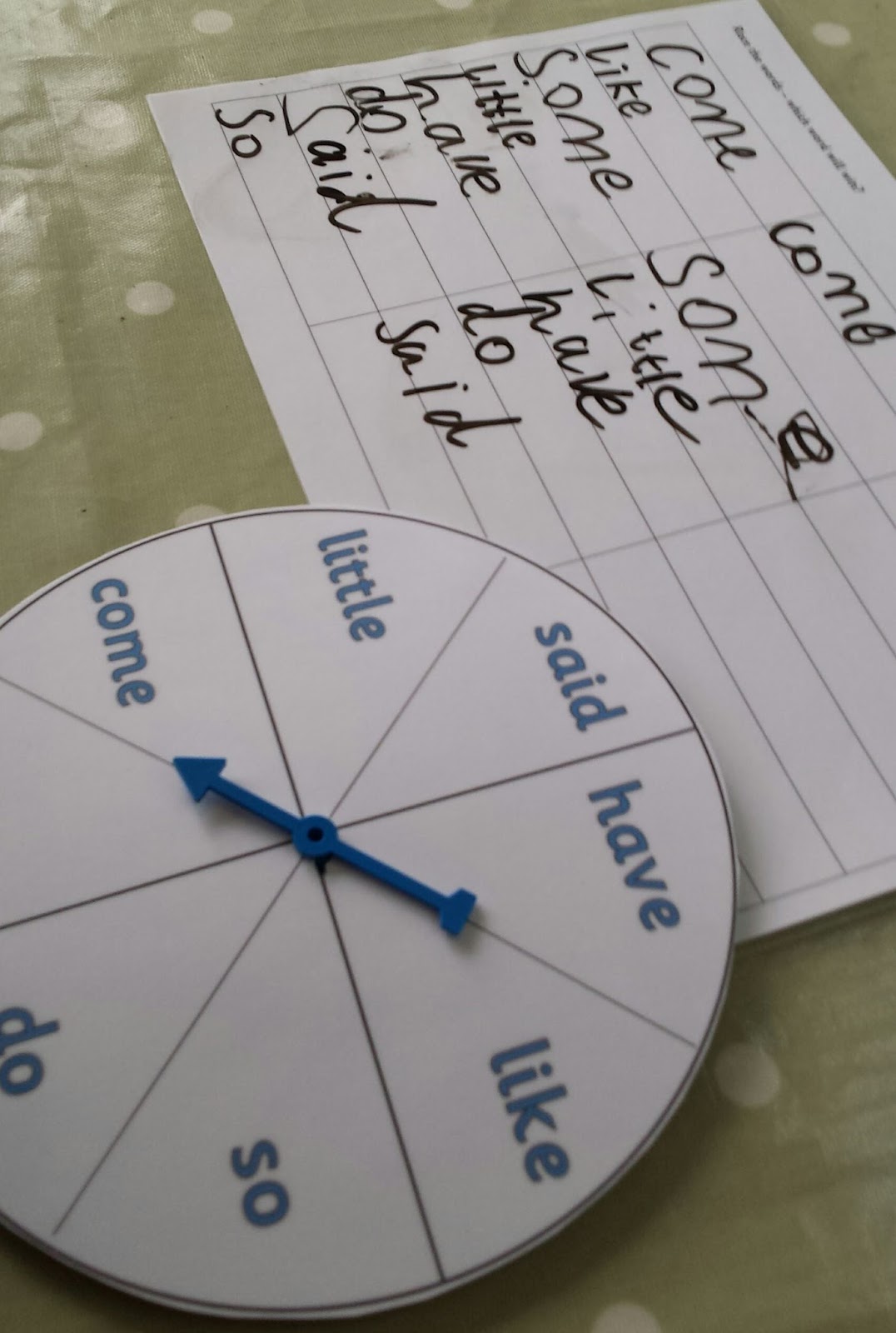
This idea is brilliant for practising all sorts of words. The image is of a session with one of the children I tutor. I have done the same session but with different words. We were working on phase 4 tricky words.
I just want to say something about tricky words. Some people seem to think that children should just learn these as sight words but evidence shows that if you teach them phonically they are much more likely to stick. You may think that some words aren't decodable. All words are decodable but there are obviously different representations of the sounds. In every word there will be something to go on.
For example /said/ has the /s/ and the /d/ which you can point out. The child needs to know that in this word /ai/ makes the /e/ sound. It is surprising how quickly they pick it up if you do point out the decodable parts and then point out the different representation of the sounds.
Back to the game. Basically it is a spinner which you can write any words in each section. I worked on cvc words with another child who isn't as far on as this one. They spin the spinner (they all love doing that) then they must read the word. When they have read it, turn the spinner over and ask them to write it in the first column and row of the grid. There are eight rows in this grid to match the number of words. They spin again and if they get a different word it goes underneath the first word. However if they spin the same word then it goes into the next column. The idea is to see which word wins. Repeat as many times as possible to practise all the words. Children love playing this game. You can buy the spinners off Amazon. and can download the word version of the spinner below. I have changed the font to comic sans due to the fact that the one I use is Sassoon primary and you may not have that one installed on your computer so it will look slightly different.
After we had played the game the word that 'won' was used in a sentence and written on the back of the laminated grid. That image is below.
Download 'Race the words'
I just want to say something about tricky words. Some people seem to think that children should just learn these as sight words but evidence shows that if you teach them phonically they are much more likely to stick. You may think that some words aren't decodable. All words are decodable but there are obviously different representations of the sounds. In every word there will be something to go on.
For example /said/ has the /s/ and the /d/ which you can point out. The child needs to know that in this word /ai/ makes the /e/ sound. It is surprising how quickly they pick it up if you do point out the decodable parts and then point out the different representation of the sounds.
Back to the game. Basically it is a spinner which you can write any words in each section. I worked on cvc words with another child who isn't as far on as this one. They spin the spinner (they all love doing that) then they must read the word. When they have read it, turn the spinner over and ask them to write it in the first column and row of the grid. There are eight rows in this grid to match the number of words. They spin again and if they get a different word it goes underneath the first word. However if they spin the same word then it goes into the next column. The idea is to see which word wins. Repeat as many times as possible to practise all the words. Children love playing this game. You can buy the spinners off Amazon. and can download the word version of the spinner below. I have changed the font to comic sans due to the fact that the one I use is Sassoon primary and you may not have that one installed on your computer so it will look slightly different.
After we had played the game the word that 'won' was used in a sentence and written on the back of the laminated grid. That image is below.
Download 'Race the words'
Sunday, 26 April 2015
Which vowel?
Some children struggle to hear that vowel in words when writing. I usually do a focus activity on that medial vowel. We go through the vowel sounds first and then I simply read a word out and the child must peg the correct vowel peg to the correct vowel sound. Great for those motor skills too.
The download consists of three vowel strips written in different order which is useful when working with a group of children, and a sheet of cvc words with all the vowels. Simple read in downward strips. These little cards could also be cut up and used as a sorting activity. Cut them all up and have 5 containers for the child to read and sort.
If working in a class situation you could just give each child a strip and one peg. The child pegs their peg to the correct vowel on the strip.
Download: Can you hear the vowel?
The download consists of three vowel strips written in different order which is useful when working with a group of children, and a sheet of cvc words with all the vowels. Simple read in downward strips. These little cards could also be cut up and used as a sorting activity. Cut them all up and have 5 containers for the child to read and sort.
If working in a class situation you could just give each child a strip and one peg. The child pegs their peg to the correct vowel on the strip.
Download: Can you hear the vowel?
Tuesday, 14 April 2015
Polysyllabic words - blending and segmenting
One of the things children find difficult is when they meet a long word. How many times do you hear children sounding out every letter and not getting the word? Teach children how to chunk the words so that they read a bit at a time then put it together. What you are actually teaching is syllables. Children read one syllable and then the next syllable. It is good to practice this skill with compound words such as sunset, giftbox, sandpit, etc.
Last night I based my lesson around syllables. I wrote the word on a whiteboard and we looked at where the vowels are. In sunset there are two vowels. Ask the child to read around the first vowel to get 'sun' and then read around the next vowel to get 'set'. Then put them together to get sunset. It takes some practice but children soon begin to chunk when reading themselves. It might be a good idea to teach children which letters are vowels. There is the vowel rap from the old ELS scheme which has a nice rap. I use this for letter sounds and letter names. It goes:
aeiou that is how we say them
aeiou that is how we play them
We say them soft
We say them loud
of our vowels we sure are proud
aeiou (shout)
aeiou (whisper)
that is how we say them
When teaching children how to write words with more than one syllable you must teach them about syllables first. Lots of practice and counting how many syllables there are in words. Either clap the syllables or get the child to put their hand under their chin as they say the word. Each time their chin touches their hand is a syllable. Try it! It works!
When spelling ask the child to say the word. How many syllables? Write the first syllable so for example in sunset there are two syllables. The child writes the first syllable 'sun' and then the second syllable 'set' to get the word 'sunset'. This really helps children with spelling.
Here is a photo of some polysyllabic words a child who is five year old was writing with me last night. She continued on the back of the white board with more words of her choice but I didn't take a photograph. She wrote oven, kitchen, pencil etc. It was as if a barrier had been opened. I am hoping for some lovely long words from her in the next few weeks. These words were totally her work I had no input what so ever apart from asking her to count the syllables, write the first syllable and write the second syllable.
Last night I based my lesson around syllables. I wrote the word on a whiteboard and we looked at where the vowels are. In sunset there are two vowels. Ask the child to read around the first vowel to get 'sun' and then read around the next vowel to get 'set'. Then put them together to get sunset. It takes some practice but children soon begin to chunk when reading themselves. It might be a good idea to teach children which letters are vowels. There is the vowel rap from the old ELS scheme which has a nice rap. I use this for letter sounds and letter names. It goes:
aeiou that is how we say them
aeiou that is how we play them
We say them soft
We say them loud
of our vowels we sure are proud
aeiou (shout)
aeiou (whisper)
that is how we say them
When teaching children how to write words with more than one syllable you must teach them about syllables first. Lots of practice and counting how many syllables there are in words. Either clap the syllables or get the child to put their hand under their chin as they say the word. Each time their chin touches their hand is a syllable. Try it! It works!
When spelling ask the child to say the word. How many syllables? Write the first syllable so for example in sunset there are two syllables. The child writes the first syllable 'sun' and then the second syllable 'set' to get the word 'sunset'. This really helps children with spelling.
Here is a photo of some polysyllabic words a child who is five year old was writing with me last night. She continued on the back of the white board with more words of her choice but I didn't take a photograph. She wrote oven, kitchen, pencil etc. It was as if a barrier had been opened. I am hoping for some lovely long words from her in the next few weeks. These words were totally her work I had no input what so ever apart from asking her to count the syllables, write the first syllable and write the second syllable.
Friday, 29 August 2014
Picture sort - beginning sounds
This is a simple activity where the child must cut out the pictures and decide which is the beginning sound.
DOWNLOAD: Picture sort
Monday, 18 August 2014
Full Circle games
Full circle
games
Ask the child to draw two lines down
their whiteboard to make a 3 box phoneme frame. Explain how each box contains
one sound. Begin by asking them to write the first word from the list. Draw a dot in the first box just like in the photo so the child knows which way the word goes. When
correct ask them to change the word to the next word on the list. They have to
think about which sound to change so they must not rub out the whole word.
Continue until you have read out all the words in the list. When the child
realises they have gone ‘full circle’ they can shout ‘FULL CIRCLE’ and put
their pen down. That makes them the winner.
I have purely concentrated
on the first 6 letters. The skills are the same no matter what the letters are
so to practising with letters they know really well is helpful. In my
experience of working with SEN children it is important to practice the skill before
bombarding with too many sounds. If children struggle to write you can use magnetic letters instead of a whiteboard pen.Make sure children are holding their pens correctly and forming letters correctly. It is easier to change bad habits now rather than later.
DOWNLOAD: Full circle games
Monday, 11 August 2014
Magnetic letters
Make a row of sounds which the child is working on.
In the early stages you might use s/a/t/p/i/n/ ask the child to make words out
of those sounds. For example sat, sit, pin, nap, pan, in, at, is, tip, tap,
nip.
How quickly can they make the words?
Hear the sound
Strips of paper with the focus graphemes (laminated
if possible) – if you are working with a group of children make sure you have
the sounds in a different order for each strip. This helps to stop children
copying. These can be downloaded for free from the Phonics for Fidgets website.
Whiteboard pens or counters
Begin the activity by asking the children to read
the sounds with you. ‘Who can find /p/? Point to it on your strip! Who can find
/n/? Point to it on your strip!’ Show the child an object and ask them to
listen carefully to the beginning sound. What sound is it? Say the word several
times if necessary, emphasizing the beginning sound. The child must find the
sound on their strip and circle it with a whiteboard pen. Or place a counter on
the sound.
Extension
Think of a word beginning with each sound. Write a
word for each sound on a white board. Have a strip of vowels a,e,I,o,u and ask
the child which vowel they can hear in a word.
Download ready made strips from this link SATPIN strips
Finger counting
Ask the child to hide their fingers behind their
back. You say a word. For example ‘cat’ the child must then count how many
individual phonemes they can hear and show you that many fingers. Here are a
few below to give you an idea. Remember a phoneme is the smallest unit of sound
you can hear in a word.
c/a/t/ = 3
c/oo/l = 3
c/r/a/b = 4
c/r/ee/p = 4
s/t/a/n/d = 5
Phoneme frames
You can easily work on phoneme frames using a
whiteboard. Children soon learn to divide the board up into 2, 3, 4 or 5 box
phoneme frames. Read a list of words with 3 sounds. One by one the child must
write each sound into a box on the phoneme frame. Some children need help to
know where to start their word so I always put a red dot for the first sound.
Extension
Use the whiteboard as a 4 or 5 box phoneme frame or
use words with 3 sounds but more letters. For example b/oa/t, l/igh/t, p/ai/n
Subscribe to:
Posts (Atom)