Showing posts with label phonemes. grapheme's. Show all posts

Tuesday, 24 May 2016

SATPIN Phonics booklet - 40 pages

This booklet will take children through the first 6 sounds of phase 2. They will learn to recognise them, write them, read them, hear the first sound and blend them. Booklet in black and white to take into account printing costs and also to allow the children to colour themselves. There are some fab monsters!
Download: Phonics Booklet


Friday, 13 May 2016

Alien game

These game cover all the phase 5 sounds except u-e. The maths just wouldn't work out to make all the sounds.

All you need is a die and some counters (2 colours, each person has a different colour). Take in turns to throw the die, read the corresponding sound and then find a word with that sound. Read the word and then cover with your counter. If all the words are gone then you miss a turn. At the end of the game the person with the most counters on their board wins.

Download: Alien game
Download: Alien game 2
Download: Alien game 3


Sunday, 19 April 2015

Clap rap

This is an old activity from ELS. - Early literacy support.
I use it a lot because it helps make learning sounds a bit more fun.
Very simple to do. Have a stack of grapheme cards. The first clap rap is showing a letter to the children and they have to shout out the sound. The second clap rap is saying the sound without showing the letter to see if they can write it down,

Right click and copy the poster below to download it.


Sorting words

Another great activity to encourage children to look carefully for vowel digraphs is 'word sort'
Children can cut and stick the word in the correct column or they can write the words in the correct column and then cross them off. Depends if they need practice at writing or cutting skills really.

Download Word sort


Monday, 16 March 2015

Roll a sound

This is a very simple activity using a die with dotty numbers, a laminated sheet, some counters or a whiteboard pen.


Each number represents a sound and the child rolls the die, finds the sound it represents and either covers it with a counter on the grid or crosses it off with a dry wipe pen.

There is one already made using satpin but I have included a word version using comic sans as the font. I am aware that many will not have sassoon.

Roll a sound

Roll a sound (word) so you can edit to put your own sounds in

Sunday, 7 December 2014

Thursday, 21 August 2014

satpin board games


Two board games to download using the 6 letters of satpin. To make games a little more interesting and a bit more competitive then give a counter, coin or sticker to the child who reads their word or sound perfectly. Who can win the most counters?

All you need to play are two counters and a die. Throw the die and read the square you land on.

DOWNLOAD: Can you blend and read?
DOWNLOAD: Do you know your sounds?

Wednesday, 20 August 2014

SATPIN assessment

Here are two sheets which can be used for assessment purposes and also the children will love doing them. All they need to do is read the graphemes or words and then they can colour a star. The aim is to colour all the stars. Great for target setting for your children. For example if they cannot read one of the graphemes then they need to practise that grapheme until they can. I will add more of these as I get further on with my phonics intervention.

Download: How many words can you read?
Download: How many graphemes can you read?

Thursday, 14 August 2014

Dice and counters

For this activity you need a die and 4 colours of counters. The child has to throw the die and choose a counter out of a bag. Find the co-ordinate and either read or write accordingly. I am a great believer in cross curricular work. If you can get some maths in there the why not? Can they do the whole grid? With the reading activity they could draw a circle around the word to say they had done it. Children could play in pairs against each other and use different colours of pen to draw their circles. Who has done the most? These sheets are purely for the first 6 letters of Jolly phonics - satpin

For letter formation print as A3 for young children who cannot write small enough.


Download: Dice and counters graphemes
Download: Dice and counters words
Download: Dice and counters letter formation

Please let me know if you like these and I can do some more sheets with different letters/words. Comment below.

Tuesday, 12 August 2014

Vowel stick

Hearing the vowels in words can often be a problem when spelling words so this little activity focuses on listening carefully for the vowel sounds. Concentrate on the short vowel sounds, so the /a/ in cat, the /e/ in bed, the /i/ in pin, the /o/ in pot and the /u/ in jug. It is a good idea to practice these sounds on a regular basis. I always used the vowel rap from ELS/ALS but using the sounds not the names of letters.

a-e-i-o-u That is how we say them
a-e-i-o-u That is how we play them
We say them soft, we say them loud
Of our vowels we sure are proud
a-e-i-o-u (whisper)
a-e-i-o-u (normal)

That is how we say them!

Use lolly sticks to write the vowels and make sure you give children their own lolly stick. Alter the sequence of the letters on each stick so children cannot copy off each other. Read out a word containing the short vowel sound. Can the child put their finger on the correct vowel?
Some examples of words would be – sat, mat, bat, ban, bad, cat, can, cap, cast, dab, damp, fan, fat, fast, gap, hat, lap, map, mat, peg, beg, leg, lend, mend, men, red, send, tend, ten, pig, pin, bin, nip, din, dip, fig, gig, jig, limp, sip, pod, bod, mod, pond, bond, cot, con, cop, hop, mop, rod, pud, mud, dud, cup, but, bun, lump, fun, sun.
Extension

Use longer words for example compound words where they have to listen for two vowels. For example tenpin, batman, fishshop, flipflop, tiptop, tinman etc

Phoneme bracelets

Some children do struggle to learn and the best way to deal with this is to do little and very often. Write the focus phoneme on a strip of card, all the way round. The child could even make their own bracelet. Tape it to the child’s wrist and during the day keep asking what the sound is. Eventually they will remember it. You might need to do this over several days. They can wear their bracelet at home too and ask mum or dad to keep asking them what the sound is.
Extension
Write more than one sound on the bracelet or write simple words for blending.

Monday, 11 August 2014

Pebble letters

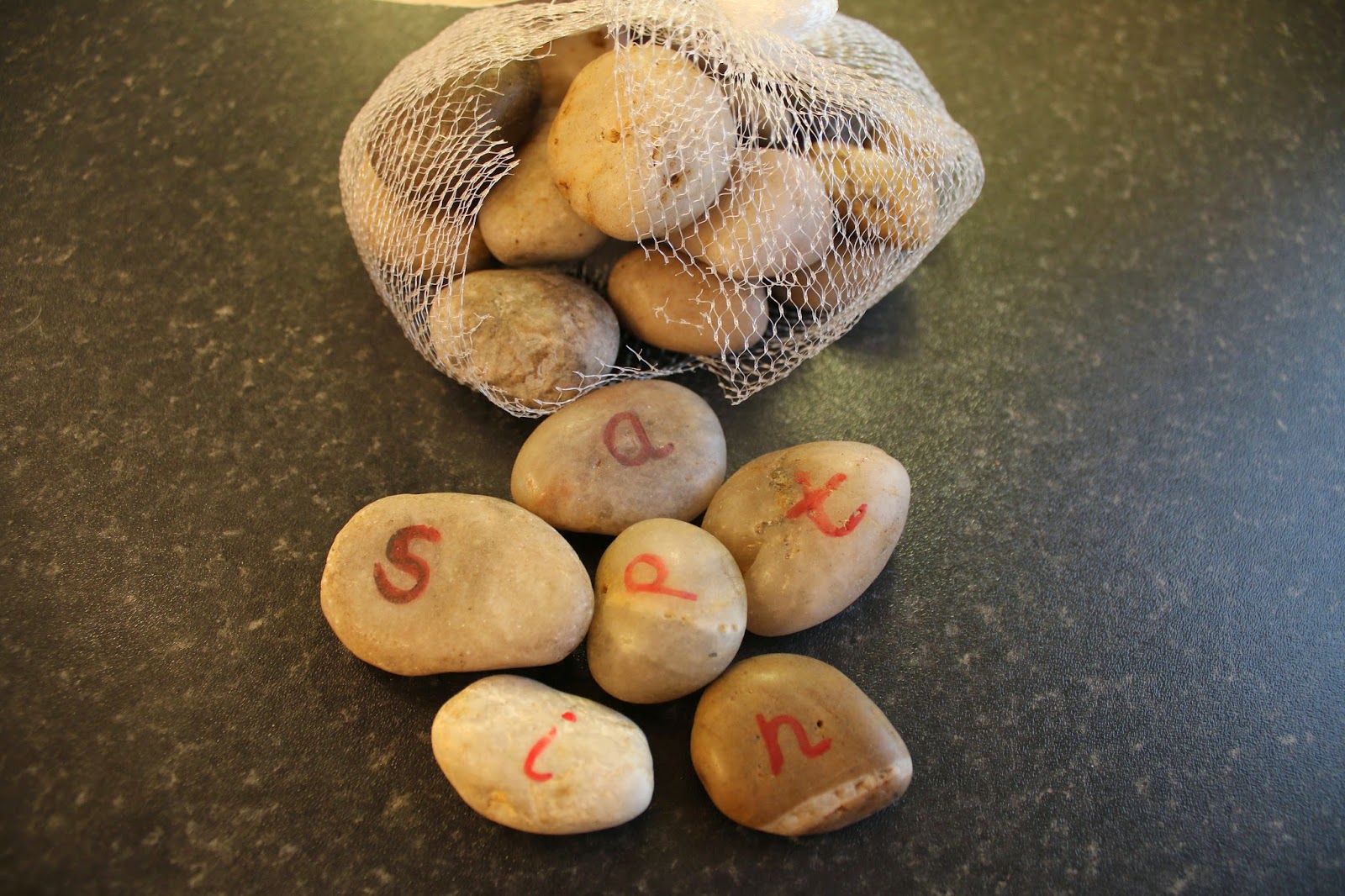
Pebbles feel lovely and children love to hold a pebble in their hand. This gives a sensory experience as well as practicing their phoneme/grapheme correspondences. They could be put in the sand tray at school or the water tray. They could copy the letters onto whiteboards or simply trace around the letter with their finger. This little bag cost next to nothing from the local garden centre.

Hear the sound


Strips of paper with the focus graphemes (laminated if possible) – if you are working with a group of children make sure you have the sounds in a different order for each strip. This helps to stop children copying. These can be downloaded for free from the Phonics for Fidgets website.
Whiteboard pens or counters
Begin the activity by asking the children to read the sounds with you. ‘Who can find /p/? Point to it on your strip! Who can find /n/? Point to it on your strip!’ Show the child an object and ask them to listen carefully to the beginning sound. What sound is it? Say the word several times if necessary, emphasizing the beginning sound. The child must find the sound on their strip and circle it with a whiteboard pen. Or place a counter on the sound.
Extension

Think of a word beginning with each sound. Write a word for each sound on a white board. Have a strip of vowels a,e,I,o,u and ask the child which vowel they can hear in a word.

Download ready made strips from this link SATPIN strips

Wednesday, 30 July 2014

Pick one and read it!

Write a sound at the top of the lolly stick and a word at the bottom. The child picks a sound, names the sound and then blends and reads the word. 

Roll the letter

Write the sounds which are on the die onto the whiteboard and add 2 or 3 extra sounds which are not on the die. Ask the child to throw the die and match the letter on the die to the letter on the whiteboard. They can cross off each letter one at a time. How quickly can they roll all six letters? How many letters are left? What are the letters that are left?

Find the sounds

A very simple activity where you write graphemes on a kitchen roll tube and also on some stickers. The child has to stick the sticker onto the same sound on the the kitchen roll tube.

Paper plate sounds

A very simple concept using a paper plate. Focus on a few sounds or all the sounds in a particular phase. All you need to do is write the sounds all around the edge of the plate, cut at each side and the child bends over the sound they hear. You could read words and they have to find the beginning sound or just say the sound and they have to find it and bend it over.
You could also ask them to spell a word for you by bending over the appropriate graphemes in the correct order.